

What are AN fittings and AN hoses?
AN fittings and hoses are special fittings and hose systems originally developed for the military (Army-Navy) for use in extreme conditions such as high pressures and temperatures. Today they are very popular with car enthusiasts, in motorsport and even in aviation, because they are extremely reliable and durable. Their main feature is the special 37° flared joint, which seals tightly and securely without extra gaskets. This means fluids such as fuel, oil or water can flow through without leaking, even under high loads and vibration.
AN hoses are often reinforced with a stainless braid or made of PTFE, suitable for carrying fuel, oil, water or hydraulic fluids. Together with AN fittings they create a modular, durable and good-looking system for all kinds of lines in vehicles.
An AN fitting consists of:
- a 37° flared body (part of the fitting)
- a ferrule (part of the fitting)
- a nut (part of the fitting)
- the hose (an AN hose of the correct size)
AN fitting sizes and matching
AN fittings and hoses come in various sizes, measured in sixteenths of an inch. For example, AN3 means an inside hose diameter of about 3/16 inch, and AN6 means 6/16 inch, i.e. 3/8 inch. The most common sizes are AN3, AN4, AN6, AN8, AN10, AN12 and AN16. It is important to choose the right size for the flow rate and the pressure the system will run.
- AN6 = 3/8″ (9.53 mm)
- AN8 = 1/2″ (12.7 mm)
- AN10 = 5/8″ (15.88 mm)
- AN12 = 3/4″ (19.05 mm)
- AN16 = 1″ (25.4 mm)
The following sizes are used for most automotive applications:
- AN3 and AN4: brake and clutch systems.
- AN6: systems for fuel delivery, hydraulic connections
- AN8, AN10 and larger: systems for oil cooling (AN8 and AN10), systems for fuel delivery (at higher power), coolant systems (AN20 and above).
When choosing fittings and hoses, the AN size must match for both (e.g.. 6AN hose with a 6AN fitting) to ensure the right diameter and unrestricted flow.
The different types of fitting
There are several types of AN fitting, depending on how they connect and what they are used for:
- Swivel fittings: they let the hose rotate during assembly, which prevents twisting and simplifies installation. They come in various shapes – straight, 45°, 90°, 180°, …
- Weld-on fittings: these are welded directly onto metal pipes or tanks, giving an extremely strong connection.
- Push-on fittings: they allow quick assembly without clamps, suitable for low-pressure systems.
- Bulkhead fittings: they pass through panels or firewalls and seal on both sides.
The different types of AN hose
AN hoses also come in various versions, depending on the application and how demanding the system is:
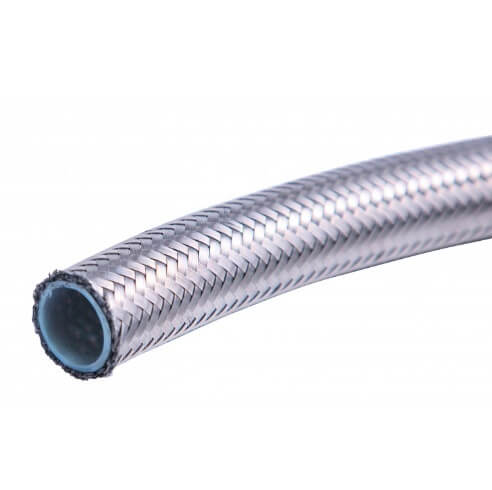
- PTFE braided hoses : extremely resistant to high temperatures, chemicals and pressure. They are often used for brakes, clutches and fuel lines, where high resistance matters.
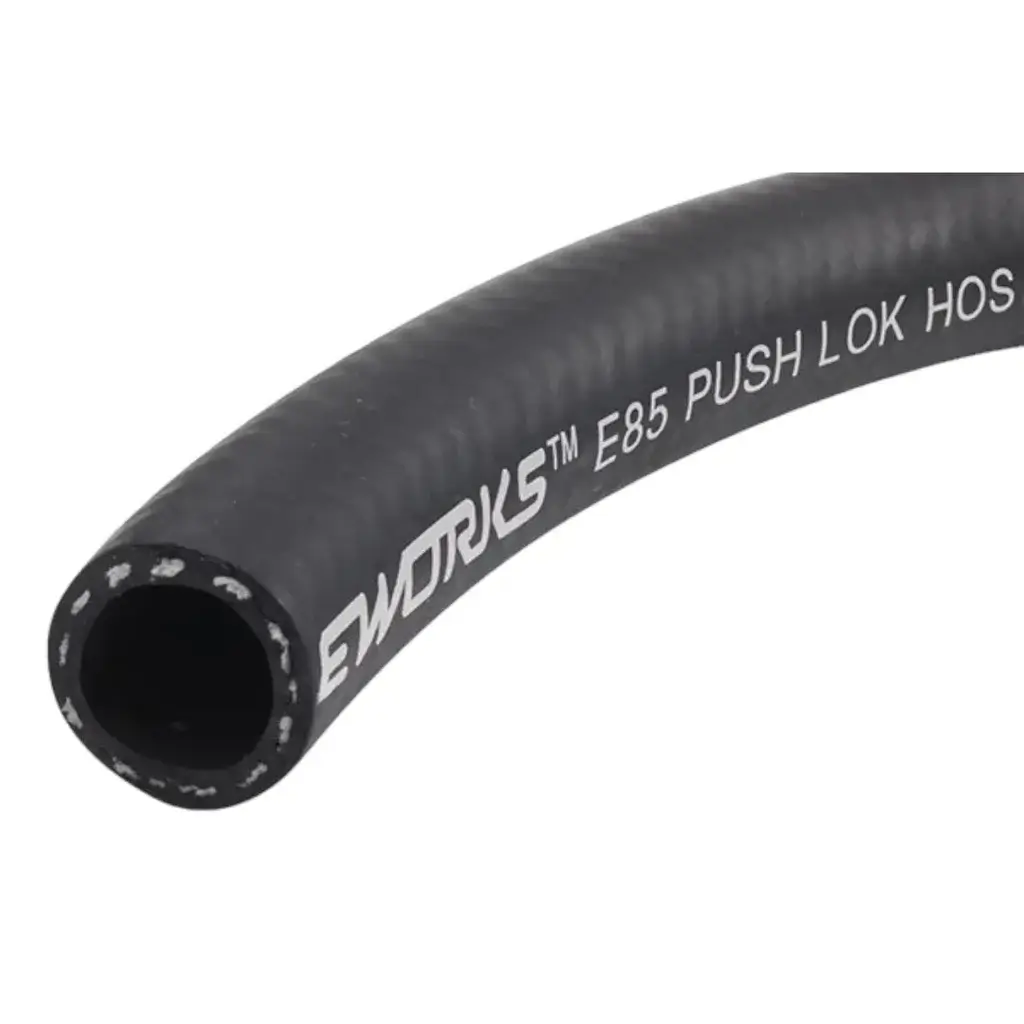
- Reinforced rubber hoses: popular for their flexibility, but less resistant to extreme conditions than PTFE hoses. They are often used for low-pressure applications such as cooling systems and return lines for fuel.
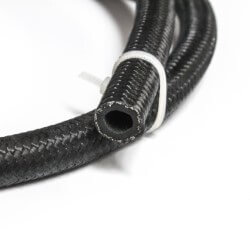
- Nylon-braided hoses: a combination of light weight and strength, suitable for fuel lines and systems for carrying oil.
Using AN fittings and hoses
AN fittings are used in various systems that need high flow, safety and resistance to high temperatures and pressures. Making up an AN hose involves a few basic steps:
- Choosing the right hose size for the application (e.g. fuel delivery, oil, hydraulics).
- Preparing the hose (cutting it to length, removing any metal debris).
- Fitting the AN fitting to the hose, which usually involves a ferrule and nut for ensuring a tight joint.
- Connecting to the system via adapters or converters if you need to change to another system (e.g. BSP, NPT).
AN fittings are especially popular in the car world and motorsport for their durability, looks and adaptability. They are also an excellent choice for builds that need quick, reliable connections between fluid systems.
Example application:
- System for oil feed on the turbo: We weld an AN10 weld-on fitting to the engine block. We make up an AN10 hose with AN10 fittings at both ends. On the turbo we fit an NPT-to-AN10 adapter, e.g. 1/4 NPT -> AN10 adapter. This is how we make up hoses for oil to the AN10 standard.
- System for fuel feed: We weld an AN6 weld-on fitting to the fuel tank. We make up an AN6 hose with AN6 fittings at both ends. On the high-pressure pump we fit a BSP-to-AN6 adapter. We route the hose from the tank to the pump and on to the engine. This gives a reliable, leak-free fuel supply.
- System for oil cooling: Namestimo adapter for an oil filter adapter with AN10 outlets. We make up two AN10 hoses (1x feed, 1x return) and route them through the oil cooler. This is how we build a system for oil cooling to the AN10 standard.
Conclusion
With AN fittings and hoses there is no universal answer or plug-and-play solution. You need to plan the system properly and then decide for the right size, fittings and hoses. They are indispensable components in motorsport and, in places, on cars for everyday use.
If you need any help with modifying your car, you can contact us. We will gladly take the time to advise you properly.
If you haven’t already, you can sign up for our newsletter using the form below. You can expect more articles like this in your inbox, plus other news from the car world, such as upcoming car meets, track days and other events.