

Every year the same scene plays out: the first snow, a car park below the ski slopes and the driver of a lowered car kneeling by the wheel, discovering that the snow chain bought to match the tyre size simply will not go on. Or it does go on, and a few hundred metres later it starts rubbing against the damper. Lowered cars, coilovers and large wheels need a different approach from the average car – in this guide we explain why, how to measure the clearance behind the wheel and which solution actually works.
Why conventional snow chains do not fit every car
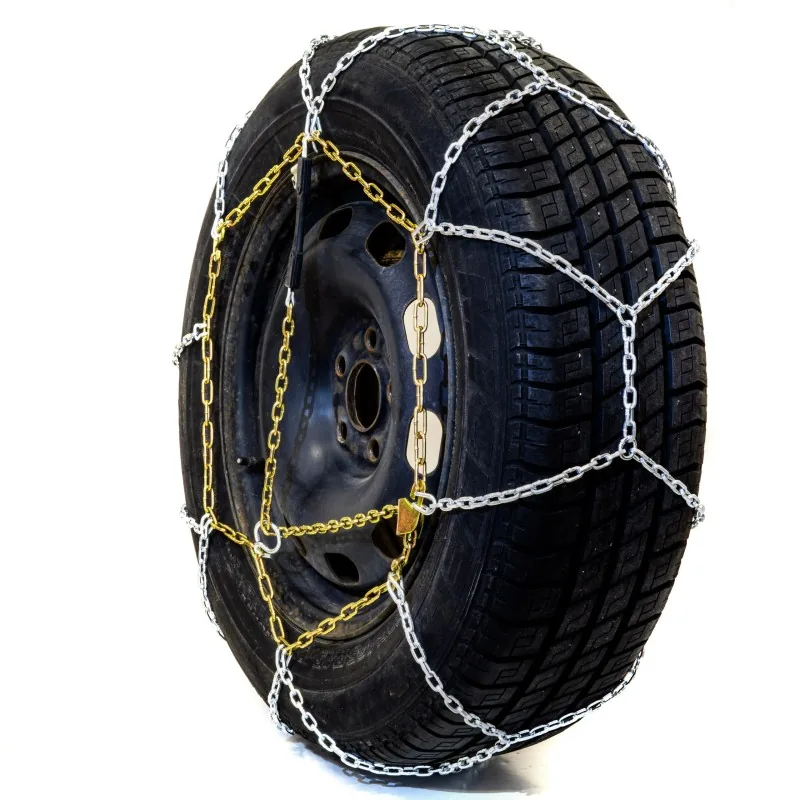
A conventional snow chain wraps around the whole tyre: one part runs across the tread, the other along the inside of the wheel, between the tyre and the suspension. That is exactly where a lowered car has the least room. The chain thickness (7, 9 or 12 mm) gives a rough idea of how much clearance it needs – and not only when the car is stationary, but also at full steering lock and with the suspension compressed.
Clearance behind the wheel is most often reduced by:
- coilovers – the spring seat is often closer to the tyre than on a standard damper,
- wider tyres and wheels with a different offset (ET) that move the wheel closer to the suspension,
- wheels of 18 inches or more with low-profile tyres – the chain sits right next to the rim edge,
- bigger brakes and sports packages, where brake hoses and sensors are close to the tyre.
The wrong chains lead to expensive consequences: rubbing against the spring or damper, a torn brake hose or ABS sensor cable, a damaged wheel arch and a scratched rim edge. It is no coincidence that manufacturers of performance models – for example BMW M and Tesla Performance – explicitly prohibit conventional chains on large tyre sizes in the owner’s handbook, or recommend one specific system.
How to measure the clearance behind the wheel
Before you buy anything, take five minutes:
- Park the car on a level surface and turn the steering wheel to full lock in one direction – this lets you see the inside of the front wheel.
- Measure the smallest gap between the inner edge of the tyre and the nearest part of the suspension (spring, damper, control arm, brake hose).
- Turn the steering to full lock in the other direction and repeat the measurement – the difference can be several millimetres.
- Also check the gap between the tyre tread and the wheel arch – this is where the tread section of the chain will travel as the suspension moves.
- Check the vehicle handbook to see whether chains are permitted for your tyre size, and in which thickness.
If there is less than about a centimetre of clearance on the inside, or if the handbook prohibits chains for your tyre size, conventional chains are not the right choice.
Three solutions for lowered cars
1. Thin 7 mm chains
If there is not much clearance but there is at least some, thin 7 mm chains are the cheapest solution. Manufacturers market them specifically for sports cars and compact cars with little room. For a car on coilovers with 19″ wheels, however, they are generally not thin enough.
2. Chains mounted from the front of the wheel
This solution was developed precisely for cars with no clearance behind the wheel. An adapter is attached to the wheel (to a wheel bolt or a dedicated anchor), and a frame with chains that cover only the tyre tread is fitted onto it. The system needs no clearance at all on the inside of the wheel and does not touch the rim, and once the adapter is set up, fitting takes a minute or two – without lying in the snow. Such systems are made by, for example, Spikes-Spider, König (K-Summit) and Michelin (Fast Grip).
They cost more than conventional chains, but in return you get the only steel solution you can fit without worry to a car lowered by 30 mm on 20″ wheels. If you need such a system, contact us via the contact form – we will find the right size and adapter for your car.
3. Snow socks
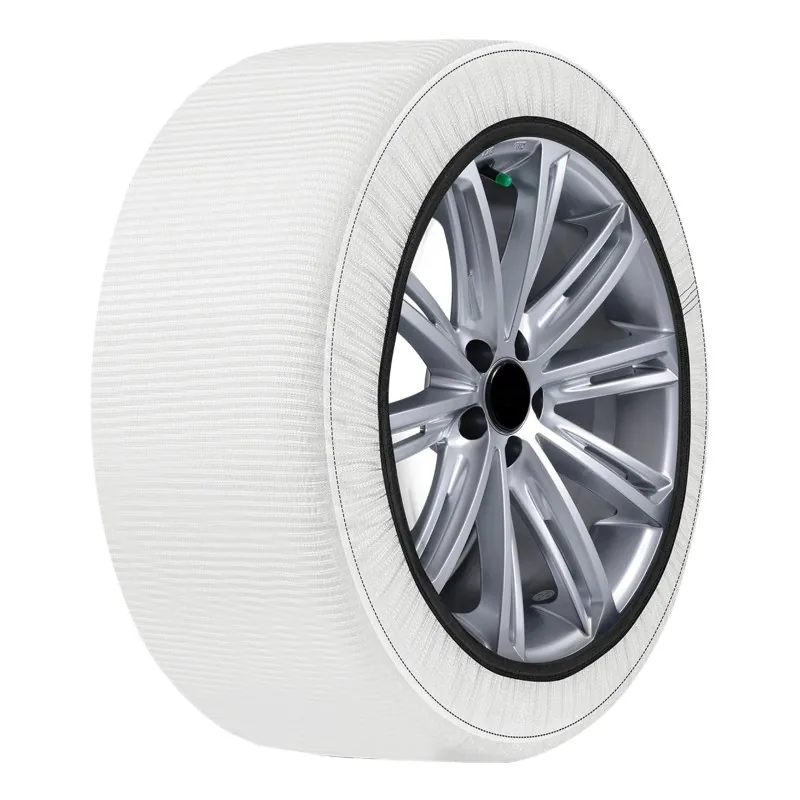
A textile cover that wraps around the tyre, needs almost no clearance behind the wheel and does not scratch the rim. It is light, inexpensive and fitted in a minute, which makes it an excellent backup in the boot for occasional driving in snow. The downsides: it wears quickly on dry tarmac, you have to drive slowly, and in Austria it is not allowed where chains are signposted as mandatory. More in the Snow socks category.
Quick comparison
| Conventional 9 mm | Thin 7 mm | Front-mounted | Snow socks | |
|---|---|---|---|---|
| Clearance behind the wheel | required | less | not required | almost none |
| Lowered car, coilovers, 18–22″ | no | rarely | yes | yes |
| Fitting | kneeling by the wheel | kneeling by the wheel | 1–2 min from the front | 1–2 min |
| Austria, chains mandatory | yes (ÖNORM V 5117) | yes (ÖNORM V 5117) | yes, if ÖNORM V 5117 | no |
| Durability on clear roads | good | good | good | poor |
Tips for coilover owners
- Raise the car for winter. Coilovers let you adjust the ride height – a few centimetres more in winter means less contact with slush, kerbs and frozen ruts, and more room for the chain under the wheel arch. After raising the car, do not forget a wheel alignment. We explained how height adjustment works in the guide How to choose coilovers (Gewinde).
- Wheel spacers push the wheel outwards and add some clearance on the inside, but at the same time reduce the room under the wheel arch. Do not choose chains just because you have spacers.
- A winter set on smaller wheels is often the best solution: 17″ wheels with a taller tyre profile leave more room for chains and are cheaper to replace if road salt or a kerb damages them. You will find a selection among our wheels.
- Test at home. Fit the chains for the first time in your driveway, not at −10 °C on a mountain pass. With adapter systems, you can attach the adapter to the wheel before you set off.
What about the law?
In Slovenia, winter equipment is mandatory from 15 November to 15 March and whenever there are winter conditions. Summer tyres are only allowed with at least 3 mm of tread and suitable snow chains in the car. Croatia, Austria and Italy have slightly different rules – especially regarding snow socks. We have put everything together in the guide Winter equipment rules 2026/27: Slovenia, Croatia, Austria and Italy.
Not sure what to choose?
Send us your car model, tyre size and suspension details (standard, lowering springs or coilovers, and how much the car is lowered) via the contact form – we will advise you which chains will actually work on your car. You will find the full range in the Winter equipment category.
If you haven’t already, you can sign up for our newsletter using the form below. You can expect more articles like this in your inbox, plus other news from the car world, such as upcoming car meets, track days and other events.