
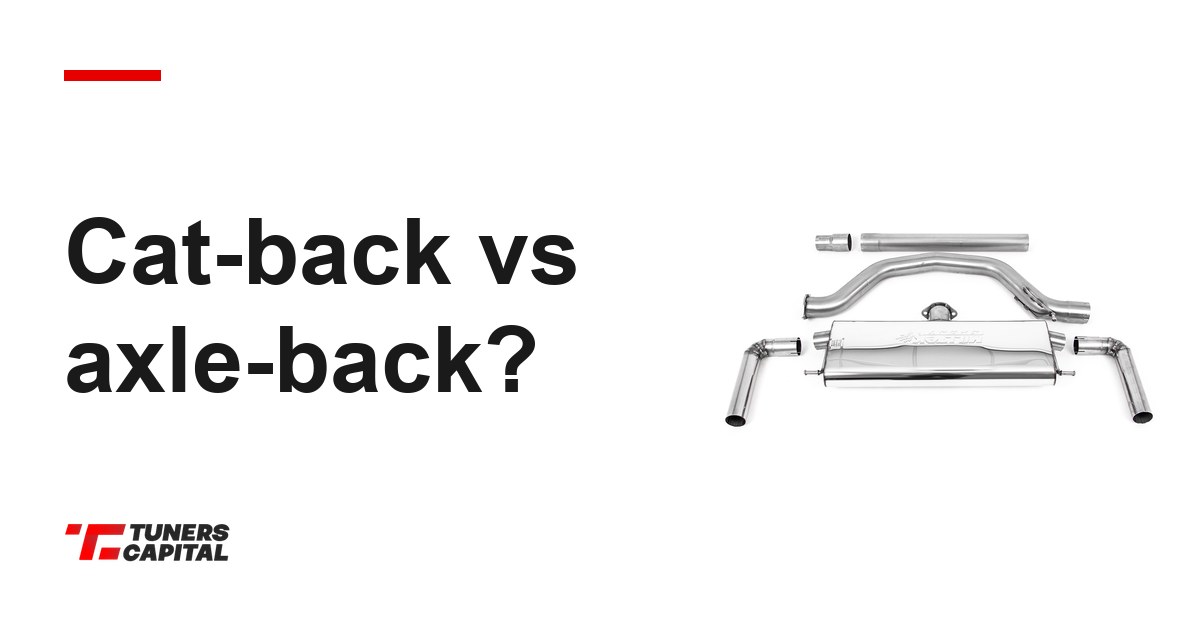
A performance exhaust is the first modification for many car owners. As soon as you start shopping, you run into a pile of terms: cat-back, axle-back, GPF-back, downpipe, centre silencer, manifold, tailpipes. Which part of the exhaust system are you actually replacing, what will you gain and how much will it cost? In this guide we explain how an exhaust is built from the engine to the tailpipe, the types of system, materials and sound valves, typical prices and what you need to know about road legality.
What does an exhaust system consist of?
On their way from the engine to the rear bumper, exhaust gases pass through several parts. Each can be replaced on its own or as part of a kit:
- Exhaust manifold (header) – collects the gases from the individual cylinders. On turbo engines it is often part of the turbine housing or the cylinder head.
- Turbocharger (on turbo engines) – uses the energy of the exhaust gases to compress the intake air.
- Downpipe – the first pipe after the turbo, usually housing the main catalytic converter.
- Particulate filter – GPF/OPF on newer petrol engines, DPF on diesels.
- Mid-pipe and centre silencer (resonator) – damp certain frequencies, above all the unpleasant drone at a steady cruising speed.
- Rear silencer (back box) – has the biggest influence on volume and tone.
- Tailpipes (tips) – the visible part of the exhaust; they affect looks and only slightly the sound.
A system is named after the point where it starts. Cat-back means “from the catalytic converter back”, axle-back “from the rear axle back”.
Cat-back vs axle-back vs GPF-back: what is the difference?
Cat-back
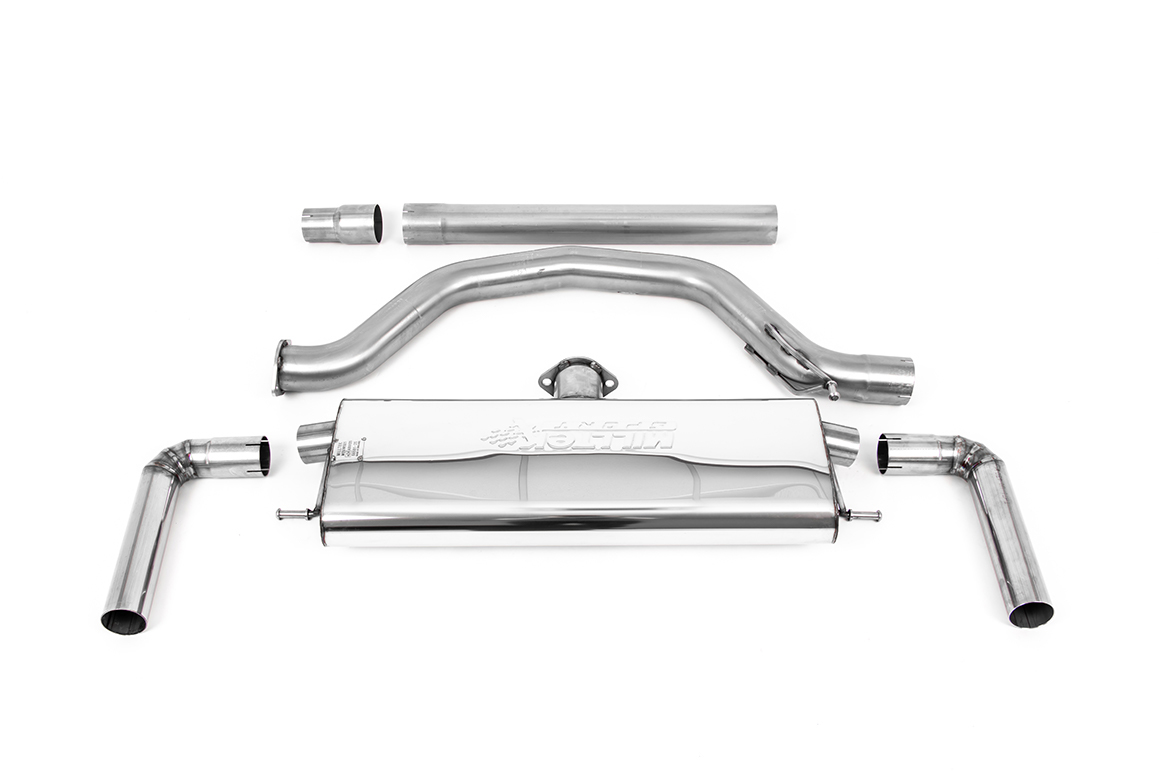
A cat-back system replaces everything after the catalytic converter: the mid-pipe, centre and rear silencers and the tailpipes. It is the most popular choice because it changes the sound and the looks while the emissions hardware stays untouched. On good products the pipe diameter is larger than stock, the bends are smoother and the welds are cleaner.
GPF-back
Newer petrol cars also have a particulate filter (GPF or OPF) after the catalytic converter. A GPF-back system starts after that filter and is effectively “cat-back for newer cars”. The filter stays in place, which makes it the usual route to a sporty sound on cars such as the Golf 8 GTI and R, Audi S3 8Y or BMWs with the B58 engine.
Axle-back and rear silencer
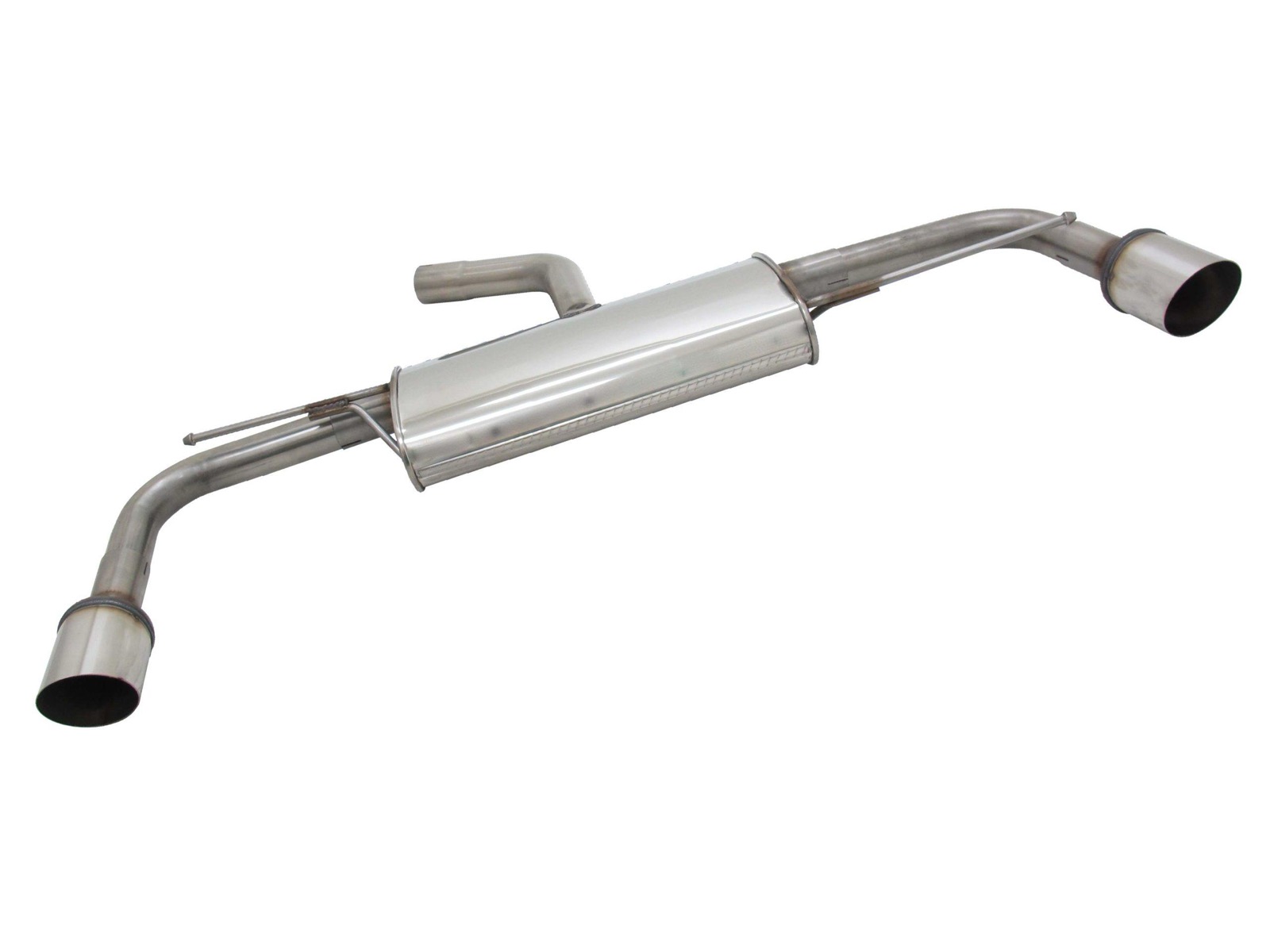
An axle-back replaces only the section behind the rear axle, usually the rear silencer with its tailpipes. It is the cheapest way to make a car sound sportier, and on many popular models it is the only exhaust modification the owner really needs. An example is the Novus rear silencer for the VW Golf 5 and 6, supplied with type-approval documentation.
Turbo-back and downpipe
A turbo-back is the complete exhaust from the turbo backwards, i.e. a downpipe plus a cat-back. This is where the real power gains on turbo engines begin – and also the strictest questions about the catalytic converter and road legality. We cover all of this in the article What is a downpipe and which type to choose.
Silencers, resonators and tailpipes: what changes the sound?
Exhaust sound is mainly down to the silencers, not the pipe diameter:
- The rear silencer sets the volume. A straight-through perforated design with absorption packing is louder than a chambered silencer.
- The centre silencer or resonator looks after comfort. Without it (“non-resonated” versions) the car is louder and rawer, but often drones on the motorway. For daily driving, a resonated version is usually the better choice. For your own combinations there are centre silencers and universal silencers.
- Tailpipes only colour the sound slightly. A bigger diameter and double-wall design give a deeper note at the outlet, but their main purpose is looks. If you like the standard sound and just want a better-looking rear end, exhaust tips and trims are the cheapest modification.
When choosing, read the version description carefully: the same manufacturer often offers several variants for one model (resonated or non-resonated, different tailpipes, polished or black ceramic coating).
Exhaust valves: can I have a quiet and a loud exhaust at the same time?
Many performance cars already have a factory exhaust flap (valve) that opens in sport mode or at higher revs. On BMWs it is often simply called a “valvetronic exhaust”. Aftermarket systems for these cars usually keep the connection for the original flap, so the drive-mode button still works.
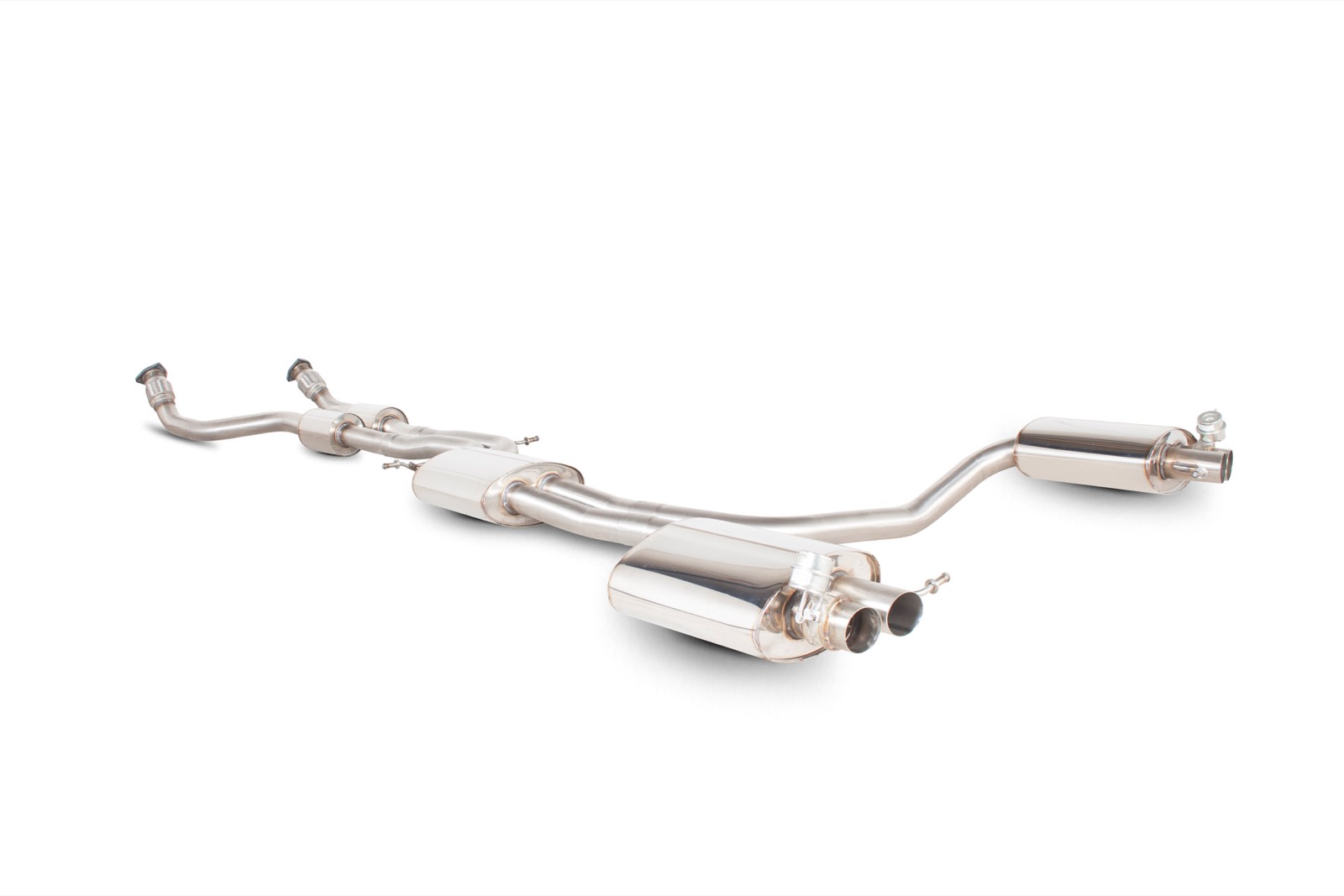
For cars without a factory flap there are systems with their own valve. Examples are the Scorpion cat-back with active valve for the Audi RS4 and RS5 B8 and the Bull-X valved rear silencer for the VAG 1K and MQB platforms. For each product, check whether it comes with road-use documentation, as several valved systems are intended for track use only.
A special case is an active sound system (sound booster) such as the THOR PRO. It creates the sound with speakers under the car while the exhaust stays standard. It is mainly of interest for diesel and hybrid cars that do not sound sporty on their own.
Stainless steel or titanium?
- Stainless steel – most quality performance exhausts are made from austenitic stainless steel (for example T304). It resists rust, handles heat well and is affordable. Standard exhausts are often made from cheaper steel that rots after a few winters of road salt, so a stainless system is also a long-term investment.
- Titanium – around 40 % lighter than steel at the same thickness and recognisable by the blue-violet hues on the welds. It is considerably more expensive, so it is most often found on tailpipes, such as the Bull-X titanium tips, and on race systems.
- Coatings – a black ceramic coating (for example Cerakote) on the tailpipes is now a popular alternative to polishing. It does not fade and needs no polishing.
How much power, weight and sound does a performance exhaust really add?
Power is where exhaust claims are most exaggerated, so let us be realistic:
- A cat-back or GPF-back on a standard engine mainly brings sound, looks and often a few kilograms less weight. The power gain is small, usually a few per cent or less, because the main restriction remains in the catalytic converter and the filter.
- On turbo engines with more power (Stage 2 and above), a free-flowing exhaust matters more. The downpipe brings the most, while a cat-back reduces the remaining back pressure. That is why on such builds the exhaust is planned together with the engine software rather than as a stand-alone modification.
- On naturally aspirated engines the manifold and the right pipe diameter do the most, but even here the gain is moderate and often requires an engine software adjustment.
- Weight is often lower than stock with stainless systems and considerably lower with titanium ones. You feel the difference on track, less so in daily driving.
Manufacturers publish rolling-road (dyno) results for individual products. These apply to their test conditions, so treat them as a guide.
Exhaust manifold: when does it make sense to replace it?
A performance exhaust manifold with equal-length runners improves the flow of gases out of the cylinders. It makes sense mainly on naturally aspirated engines and builds with a bigger turbo. On modern turbo engines the manifold is often integrated into the cylinder head or the turbo and cannot be replaced separately.
Pay particular attention to the markings on manifolds. Many are labelled “motorsport only” and have no road-use documentation. A manifold affects emissions, so it also requires appropriate engine tuning. Heat losses and heat soak around it can be reduced with exhaust heat wrap.
Is a performance exhaust road legal?
The short answer: an aftermarket exhaust needs proper documentation – EU type approval (E/e marking; for replacement silencers under UN ECE Regulation No. 59) or an equivalent report such as a German TÜV/ABE certificate – and the modification has to be accepted under the rules of the country where the car is registered. A certificate in the glovebox is not always enough: the rules for registering modifications and noise limits differ from country to country, so check with your local vehicle inspection authority before fitting. For every exhaust in our shop we state whether it comes with road-use documentation. Only buy products marked “track use only” if you really drive on track.
For cars registered in Slovenia, the procedure, differences between manufacturers and the most common mistakes are described in our article Type approval for performance exhausts in Slovenia.
How much does a performance exhaust cost?
Prices in our shop (October 2026, incl. VAT) fall within these ranges:
| Modification | Typical price | Example |
|---|---|---|
| Exhaust tips and trims | from ~€30 to ~€800 | TA Technix €30–60, HG Motorsport mostly up to ~€250, Bull-X titanium €519 |
| Universal and centre silencers | ~€80–210 | TA Technix universal silencers €83–135 |
| Rear silencer (axle-back) | mostly ~€170–290 | Novus for Golf 5/6 €399 |
| Cat-back system | mostly ~€1,000–2,800 | Scorpion Golf 6 GTI non-resonated €1,209, Scorpion RS4 B8 with valve €3,778 |
| GPF-back system | mostly ~€1,100–4,000 | Milltek Golf 8 with black tailpipes €1,734 |
| Exhaust manifold | from ~€100 to over €3,000 | TA Technix mostly ~€100–550, Milltek ~€550–3,300 |
Add fitting at a garage and, where needed, the cost of approving the modification. On most cars a cat-back or GPF-back is a bolt-on job with no cutting; universal silencers require welding. Product prices may change, so always check the current price on the product page.
Milltek, Scorpion, Novus and others: which brand to choose?
- Milltek Sport (UK) – the widest choice of cat-back and GPF-back systems for VAG, BMW, Mercedes, Porsche and others. The vast majority of systems are EC approved, making them the first choice for road cars.
- Scorpion (UK) – systems with a pronounced sound, including valved versions and carbon tailpipes. They do not carry TÜV certification and are aimed mainly at track use.
- Novus (Germany) – rear silencers and systems with type-approval documentation, including for older and less sporty models. The most affordable road-legal sound.
- HG Motorsport (Germany) – tailpipes, resonator deletes and Bull-X silencers for VAG platforms.
- TA Technix – universal silencers, tailpipes and exhaust manifolds.
What to watch out for when fitting?
- Check the version for your model. Exhausts for the same model differ by engine, drivetrain (4×4 or not) and year (pre- or post-facelift).
- Replace gaskets and clamps. Old flange gaskets often leak, which you hear as ticking or whistling.
- Check the hangers. Worn rubber mounts cause knocking against the body. With stiffer systems, exhaust hanger bushes can help.
- Align the tailpipes before tightening the clamps. They should sit at an equal distance from the bumper.
- Drive gently for the first miles. The packing in the silencers needs to settle, and the sound still changes over the first hundred kilometres or so.
Frequently asked questions
Does a performance exhaust damage the engine?
No. A cat-back or GPF-back changes nothing the engine needs to run. The claim that an engine “needs back pressure” does not hold for modern engines either. Care is only needed with changes to the catalytic converter or particulate filter, which affect how the electronics work and the car’s road legality.
Do I need to remap the engine after fitting an exhaust?
Not with cat-back, GPF-back or axle-back systems. With a downpipe, manifold or catalytic converter removal, a software adjustment is usually essential, otherwise the engine warning light may come on.
Will the car be too loud on the motorway?
It depends on the version. Resonated systems are about as quiet as standard at a steady speed. Non-resonated versions with straight-through silencers can drone at 130 km/h. If you do a lot of motorway driving, choose a resonated version or a valved system.
What does “EC approved” mean for an exhaust?
It means the product has European type approval for road use. That is the precondition for the modification to be accepted and, where required, entered in the vehicle documents. Without it you may still run into trouble at an inspection or a roadside check. The exact procedure depends on the country of registration – check with your local vehicle inspection authority.
Can I replace just the tailpipes?
Yes. Tips that clamp onto the existing pipes are the cheapest visual modification and have almost no effect on the sound. When choosing, check the diameter of the existing pipe and the space in the bumper cut-out.
Which performance exhaust is right for your car?
You will find the full range of more than 6,500 products in the Exhausts category, where you can filter by vehicle, system type and brand. If you are not sure what to choose, send us your car model, engine and current modifications via the contact form and tell us what you want to achieve: sound, looks or power. We will recommend which exhaust system makes sense for your goal and budget.
If you haven’t already, you can sign up for our newsletter using the form below. You can expect more articles like this in your inbox, plus other news from the car world, such as upcoming car meets, track days and other events.