
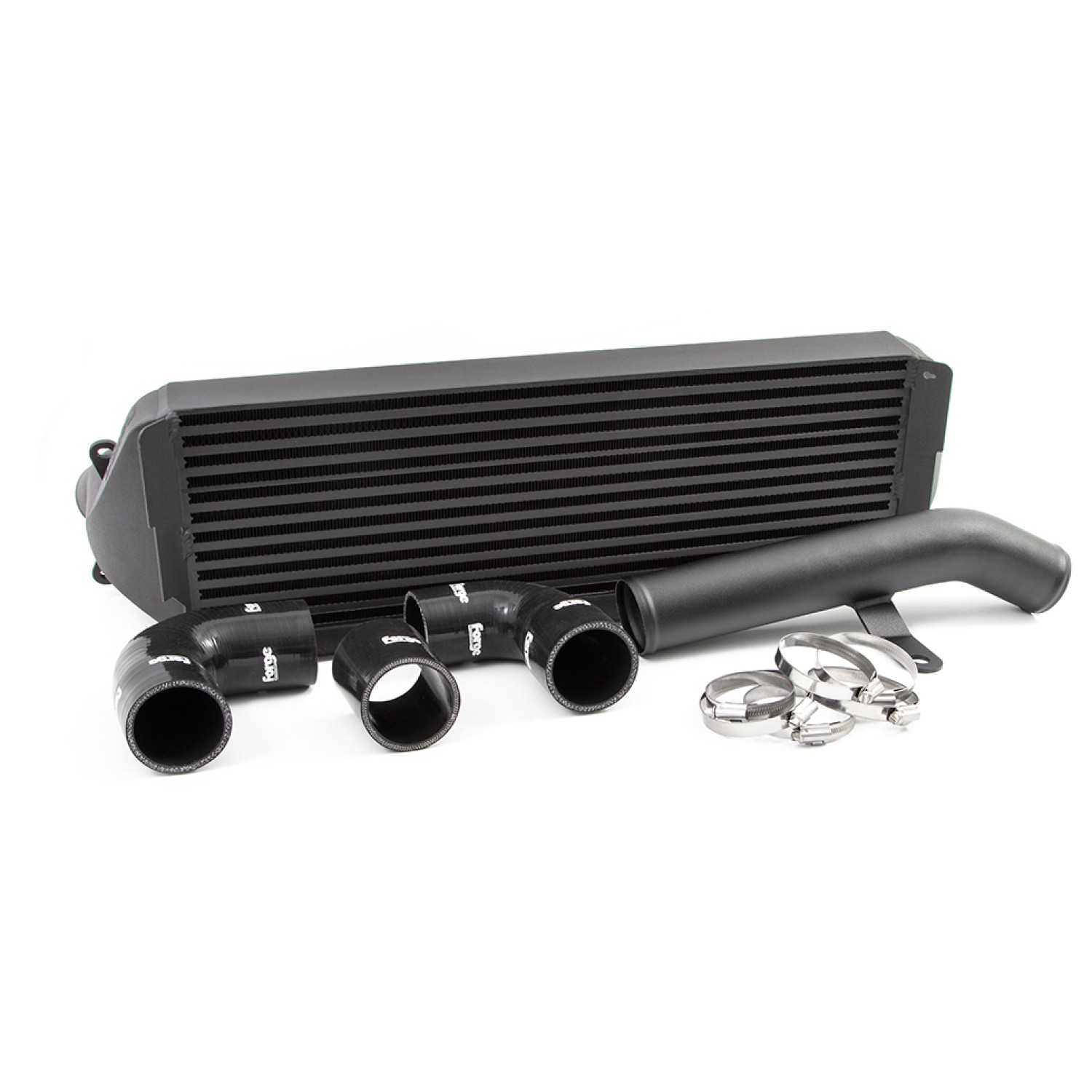
The Forge Motorsport intercooler for the Hyundai Veloster N is designed to provide more efficient charge-air cooling during fast road driving and in vehicles with high-performance software upgrades, particularly in hot climates.
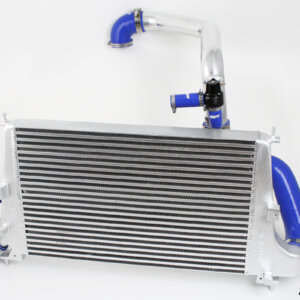
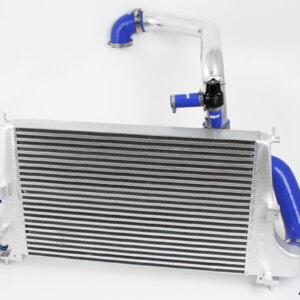
The intercooler uses a bar-and-plate core developed with Solidworks CAD modelling and CFD flow simulations. The high-flow cast end tanks feature an internal divider on the turbo side, ensuring that the entire volume of the stepped core is utilised.
The core volume is increased by more than 129%, while the frontal area is increased by more than 71% compared with the standard intercooler. For the most efficient cooling possible, a purpose-built air-direction system has also been added, matching the inner contour of the front bumper on the Veloster N.
The inlet and outlet diameter has been increased to 65 mm, making the volume 27% larger than that of the standard intercooler. The kit also includes a purpose-built hard pipe, whose diameter has been increased by 14 mm – from the standard 50 mm to 64 mm. This pipe replaces the standard pipe on the hot side of the system. The intercooler and charge pipe are protected with a standard black textured powder coating.
After testing different core designs, a high-quality bar-and-plate design was selected, of the type also used in Forge Motorsport intercoolers for the Audi RS3 and TTRS 8S. The result is minimal pressure drop.
During testing, intake air temperatures (IAT) were reduced by half. The vehicle was first subjected to heat saturation on the dynamometer until the radiator fans were cycling on and off, resulting in an inlet temperature of approximately 40 °C. A measured run was then performed, making the results more repeatable and closer to conditions during everyday driving.
After more than six measured runs, IATs remained safe. The Forge intercooler reached 24 °C, while the standard intercooler reached 48 °C. Testing took place at a relatively cool dynamometer cell temperature of 15 °C. At higher summer temperatures, the standard intercooler and higher charge-air temperatures can significantly affect engine performance. To prevent detonation, the ECU may reduce ignition advance, resulting in lower power; in a vehicle with modified software, the effects may be even more pronounced.
In combination with the Forge intake system and a quality aftermarket cat-back exhaust system, testing showed an increase in power and torque over Hyundai’s stated figures of 275 bhp and 278 lb/ft. The result achieved was 307 bhp and 347 lb/ft.
Usage limitation: the product is intended for pre-facelift Hyundai Veloster N T-GDI vehicles, model years 2019–2020.
Suitable for: Hyundai Veloster II (JS).
Compatible vehicles (manufacturer data)
| Vehicle | Chassis | Years | Engine |
|---|---|---|---|
| Hyundai Veloster | — | 2019–2020 | N T-GDI (Pre-Facelift) |
Before ordering, check that the product matches your vehicle (model, year and engine). If in doubt, write to us — we will check for you.
Reviews
There are no reviews yet.