
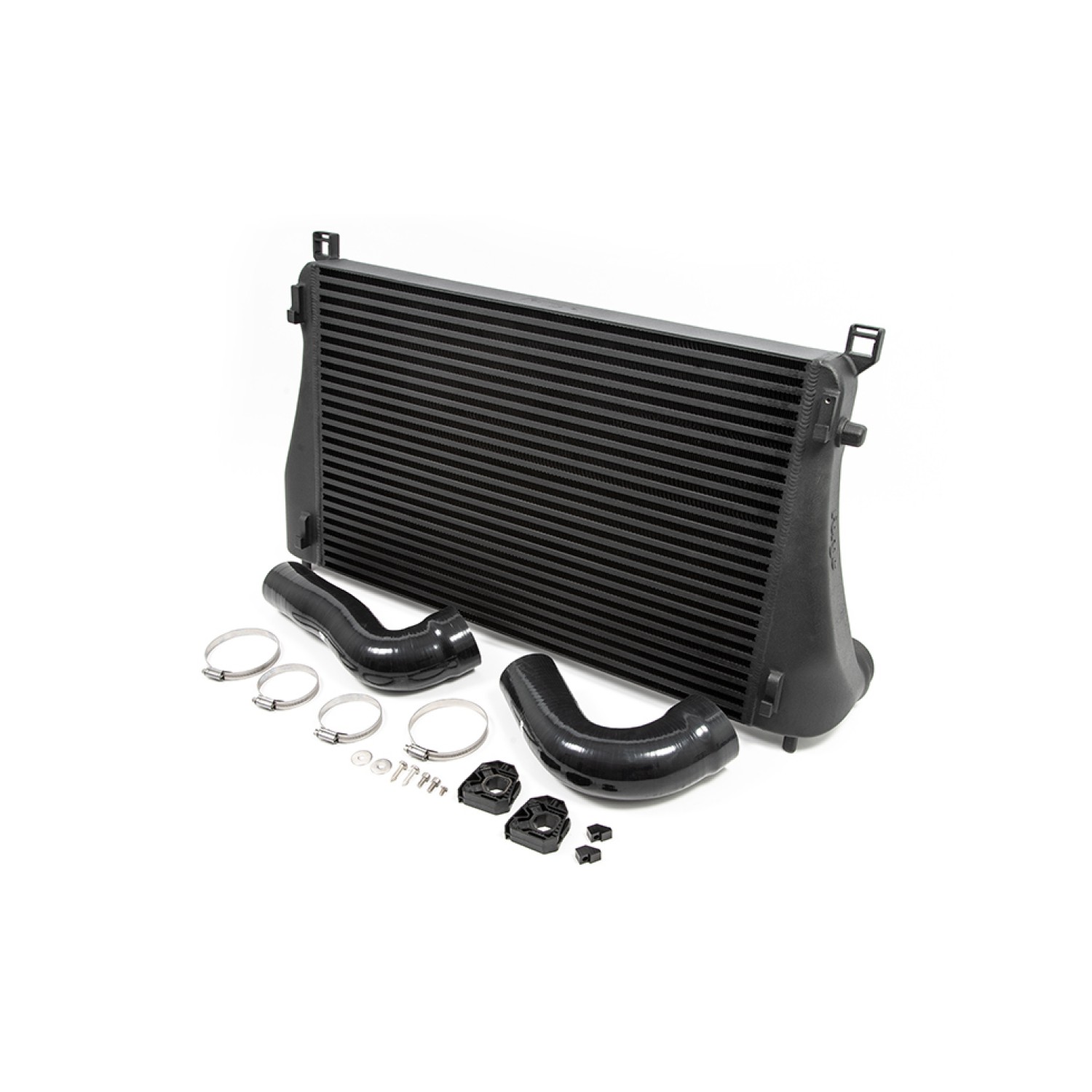
Main benefits:
- Up to 11 hp gain
- Up to 20 Nm torque gain
- Up to 58% reduction in intake air temperature (IAT)
- Made in the United Kingdom
- 76 mm inlet and outlet connections (63 mm original)
- 83% more volume than the original intercooler
- Installation without cutting the vehicle – 100% direct fit
- High-flow cast end tanks with directional baffling for optimal airflow and efficient cooling
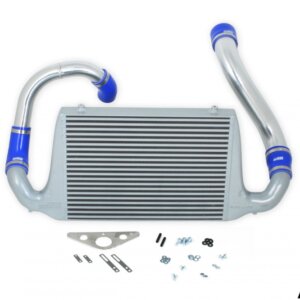
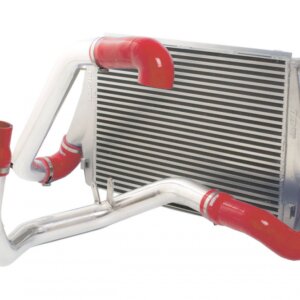
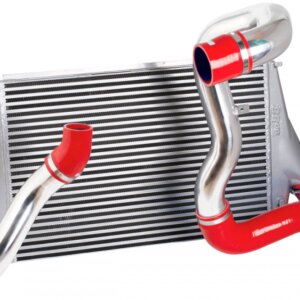
FMINT24 is a high-performance intercooler for the MQB platform, 2.0 DNF engines and EA888 EVO4 engines from 2021 onwards. The product was designed, manufactured and tested at the Forge Motorsport development centre in Gloucester, United Kingdom. The aim of the development was to improve the efficiency and performance of the EA888 Gen.4 engine by using all the available space in the original intercooler location and reducing intake air temperature without negatively affecting boost pressure or engine and transmission cooling.
The intercooler housing is highly restricted on vehicles with the MQB chassis, as the front section contains a number of radiators and the air-conditioning condenser alongside the intercooler. The front panel is designed as a package of auxiliary cooling components. Increasing the size of the intercooler without affecting the operation of the surrounding components is therefore challenging, as available space is very limited.
Development began by adapting the existing FMMK7FMIC intercooler, designed for the MK7 platform, for the development VW Golf MK8 R. The inlet and outlet diameters and the volume were then increased for improved flow and to prepare for use with heavily modified EA888 Gen.4 stage 3+ engines.
A combination of scanning software and conventional measurement methods was used to create the design. The design was then further refined using computational fluid dynamics (CFD) simulations, while the end tanks were initially produced using 3D printing. This allowed a perfect fitment on the vehicle to be verified before prototype castings or machined one-piece end tanks were produced for dynamometer testing.
Several versions of the internal baffling were developed and simulated to achieve maximum performance, maintain optimal core operation and use the entire internal volume for efficient cooling.
Specially developed silicone hoses were also required due to the increased inlet and outlet diameters. A transition is formed inside the hoses, making the connection between the hose and the hot or cold side of the fittings as smooth as possible. This reduces flow disturbance and unwanted turbulence. The inlet and outlet diameters are increased from the original 63 mm to 76 mm, giving a 45% larger cross-sectional area.
The considered design and limited space required the development of several intercooler cores with different fin configurations and internal volumes. Based on the test results, a bar and plate design was selected, with more than 83% greater volume than the original intercooler and a 10% larger frontal area.
Why do we test different cores?
When developing a Forge Motorsport intercooler, several different cores are tested for each application. These include bar and plate and tube and fin cores, different fin spacing and heights, and different internal spacing, shapes and fin densities inside the tubes. This makes it possible to accurately determine the pressure drop created by the intercooler.
Pressure drop is not always a bad thing. Testing has shown that slowing the speed of the compressed air in the intercooler allows more time for the air to cool as it passes through the core, which is exposed to the outside air.
Excessive pressure drop can cause problems on higher-performance engines, as the turbocharger has to work significantly harder to push air through the core. The increased load generates more heat and intake air temperature rises. The absence of pressure drop is not optimal either, as in this case the intercooler does not cool the charge air sufficiently.
Dynamometer results
Testing was carried out at Performance Remap in Gloucester on a VTEC four-wheel-drive dynamometer. Installing the Forge Motorsport high-performance intercooler increased peak power by 11 hp compared with the original setup, while torque increased by 20 Nm at 5500 rpm.
There are also significant torque gains across the entire rev range, allowing the engine to develop power more quickly and maintain it all the way to the redline. A power gain between 5000 and 6500 rpm is also noticeable. On vehicles with modified software and additional performance parts, gains can be even greater due to the significant reduction in intake air temperature.
During testing, the vehicle was loaded on the dynamometer until the radiator fans switched on and off, resulting in an intake air temperature of approximately 40°C. A new measurement run was then carried out, providing a more repeatable result and better reflecting everyday driving conditions. The Forge intercooler cooled down more quickly and achieved a significantly greater temperature reduction than the original intercooler.
After more than six dynamometer runs, intake air temperature at 6548 rpm was 34°C, which is 58% lower than with the original intercooler. The original setup reached 58°C at 6508 rpm. Testing took place under relatively high ambient conditions, with a dynamometer cell temperature of 23°C.
At higher temperatures, the original intercooler and higher intake air temperature can significantly reduce engine performance. In these conditions, the engine electronics reduce ignition advance to prevent detonation, causing power to drop. On a vehicle with modified software, the effect can be even greater, while engine loads also increase.
Why do we reduce intake air temperature?
Cooler air is denser and contains more oxygen. This improves combustion in the cylinders when the appropriate amount of fuel is added. By regulating and reducing air temperature, it is easier to maintain a safe air-fuel ratio (AFR), which can improve engine reliability and performance and increase power and torque.
The Forge Motorsport intercooler fits directly to the original mounting points, making installation easy and requiring no cutting of components. The installation can be reversed at any time and the vehicle returned to its original condition. The core and end tanks are protected with a black textured anti-corrosion coating, which also contributes to thermal performance and a discreet OEM+ appearance.
Suitable for: Audi S3 IV (8Y), Audi SQ2 I (GA), Audi TT III (FV), Audi Tts II (8S), Cupra Ateca I (KH7), VW Arteon I (3H), VW T-Roc I (A1), VW Tiguan II (AD1).
Compatible vehicles (manufacturer data)
| Vehicle | Chassis | Years | Engine |
|---|---|---|---|
| Audi S3 | 8Y | 2020–2026 | 8Y Onwards), 8Y Sportback Onwards) |
| Audi SQ2 | SQ2 | 2022–2026 | — |
| Audi TT | MK3 | 2021–2026 | —, 45 TFSI Onwards) (8S) |
| Cupra Ateca | — | 2023–2026 | 2.0 TSI |
| Volkswagen Arteon | — | 2020–2026 | R |
| Volkswagen T-Roc | — | 2022–2026 | R Onwards) |
| Volkswagen Tiguan | MK2 | 2021–2026 | R s (Gen 4) |
Before ordering, check that the product matches your vehicle (model, year and engine). If in doubt, write to us — we will check for you.
Reviews
There are no reviews yet.