
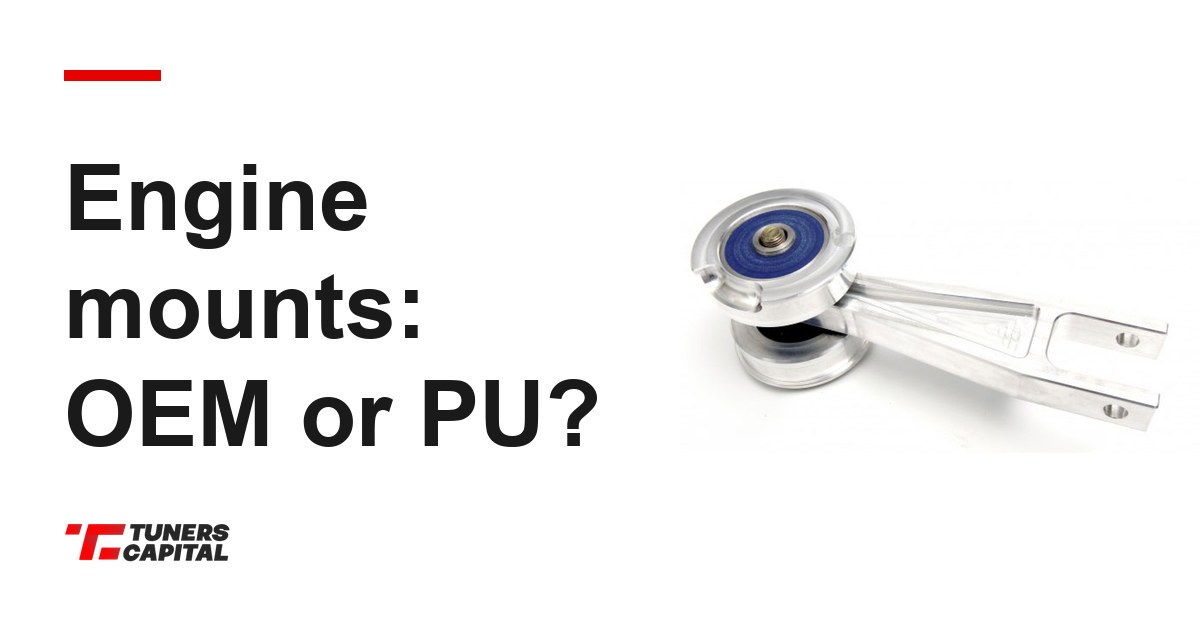
A cold morning, you start the engine and everything in the cabin shakes: the steering wheel, the gear lever, the mirrors. Once the engine warms up, it is almost back to normal. A common culprit for this kind of “winter” vibration is a worn engine mount. Mounts are a part most owners only notice once it can no longer be ignored. In this guide we explain what engine and gearbox mounts do, how to recognise wear, how OEM, uprated and polyurethane mounts differ, and how much a replacement costs.
What is an engine mount and how many does a car have?
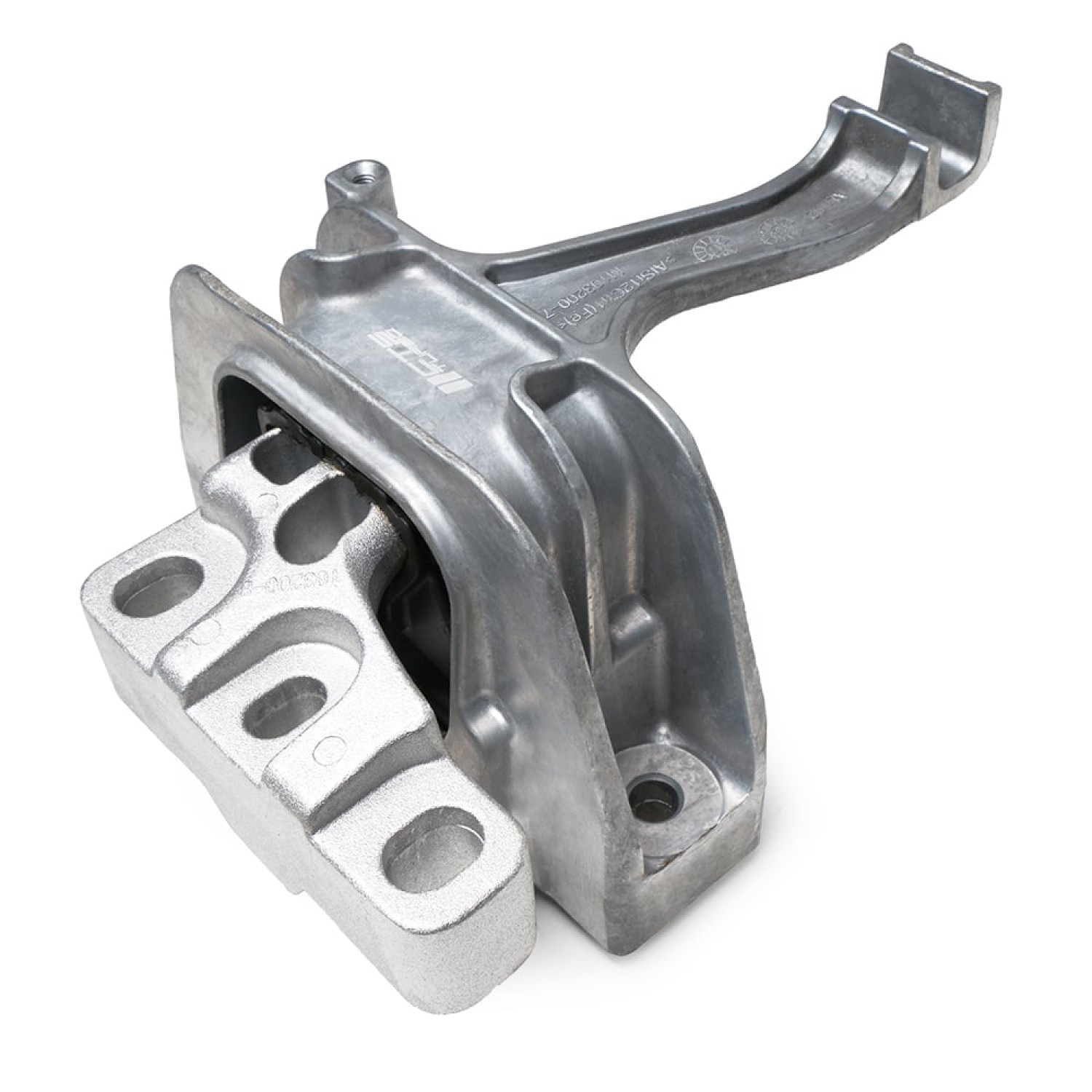
An engine mount connects the engine and gearbox to the body or subframe. It has two jobs that work against each other: it must hold the engine in place while it delivers torque, and at the same time damp vibrations so you do not feel them in the cabin. That is why every mount has a metal housing and an elastic rubber part, and some designs also have a hydraulic fill.
Most cars with a transverse engine (VW Golf, Audi A3, Škoda Octavia, Hyundai i30 …) have three mounts:
- right-hand engine mount – carries the weight of the engine on the belt side,
- left-hand gearbox mount – carries the gearbox,
- lower mount or torque arm (the “dogbone”) – connects the bottom of the engine to the subframe and stops the engine rocking back and forth under torque.
Longitudinal engines (most BMWs, Audi A4/A6 and similar) usually have two engine mounts and a separate gearbox mount. On newer vehicles some mounts are hydraulic or even active, with electronic control.
What are the signs of a worn engine mount?
Over time and with heat from the engine bay, the rubber hardens, cracks and tears, and hydraulic mounts can lose their fill. Typical signs are:
- Vibration at idle that you feel through the steering wheel, seat or gear lever – often worse in D on an automatic or with the air conditioning on.
- A knock or “clunk” when pulling away, when changing gear, or when you lift off the throttle and press it again.
- Heavy shaking when starting and switching off the engine.
- Less precise gear changes on a manual, because the gearbox moves together with the engine.
- Wheel hop under hard acceleration from a standstill.
- Visible cracks in the rubber, rubber separated from the metal, or traces of oil under a hydraulic mount.
Why does wear show up first in winter?
A cold engine runs rougher and at higher revs after starting, and the rubber in the mounts is harder and damps less at low temperatures. A worn mount that was still doing its job in summer passes the vibration straight into the body in winter. If the shaking settles after a few minutes of driving, that is a good reason to have the mounts checked.
Similar symptoms can also be caused by ignition coils, spark plugs, a dual-mass flywheel or an irregular idle. So it is best for the mechanic to rule out engine faults first and only then put it down to the mounts.
How do you check engine mounts?
- Visual inspection – with the engine off, check the rubber on the visible mounts: cracks, torn rubber, oil, or an engine that clearly “sits” lower on one side.
- Watching the engine – with the bonnet open, a helper watches whether the engine visibly rocks or jumps when it starts, with a light blip of the throttle, or when it is switched off.
- Inspection on a lift – the lower mount can only be seen from underneath. The mechanic uses a lever to check for play in the rubber.
Do not carry out tests in gear with throttle on a stationary car while standing in front of it – leave them to the mechanic on a lift, or at least do them with the car properly secured (handbrake on, wheels chocked).
What happens if you do not replace a worn mount?
When one mount fails, the other two have to do more work and wear out faster. The engine moves more under torque, which puts extra strain on the driveshafts, the exhaust and its flexible joint, the hoses and cables in the engine bay, and the gear linkage. On more powerful cars, for example after a Stage 1 or Stage 2 remap, this shows up even sooner, because the mounts carry more torque than they were designed for at the factory.
OEM, uprated rubber or polyurethane engine mounts: what is the difference?
When replacing them, you have four types of solution. They differ in how much engine movement they allow and how much vibration they pass into the cabin.
Original mount (OEM)
The same part the car had from the factory. The softest and quietest, but on more powerful engines and with spirited driving also the quickest to wear. The right choice for a standard car that you mostly drive around town.
Mount with harder rubber
The housing is the same as the original, but the rubber is harder and has no voids. An example is the CTS Turbo Street Sport engine mount for MQB/MQB Evo with 60-durometer rubber, which is still intended for daily driving. For the lower mount, CTS Turbo offers a dogbone mount for MQB and MQB EVO with 65-durometer rubber instead of the factory 55.
Polyurethane inserts
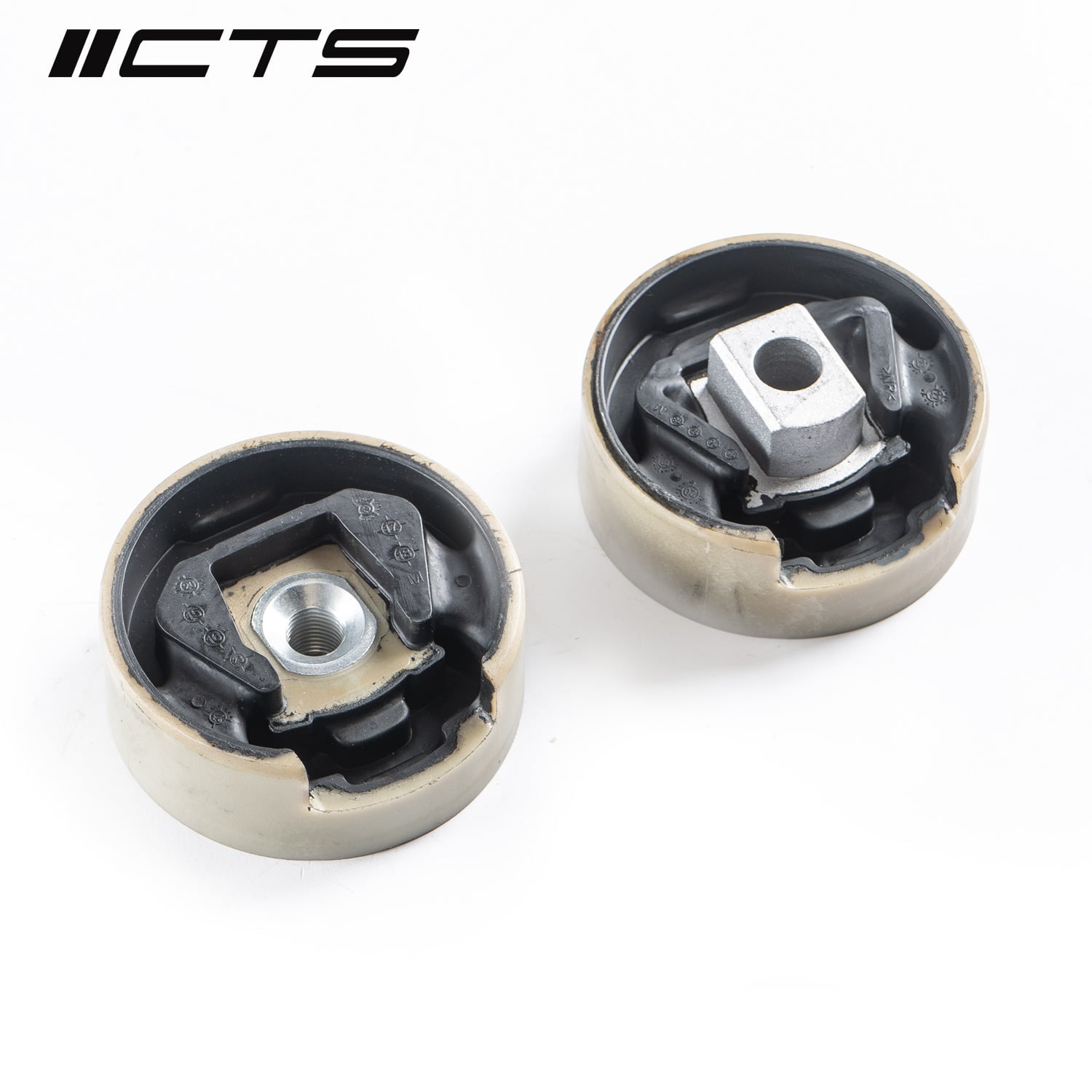
The standard mount stays in the car and the soft rubber inside it is replaced by a polyurethane bush. This is the cheapest way to reduce engine movement. Powerflex offers three hardnesses for the Hyundai i30 N: the yellow Fast Road 70A for daily driving, the purple Track 80A and the black Motorsport 95A, which is not intended for daily driving. For VAG MQB there are inserts from Forge Motorsport, Leyo Motorsport and Racingline Twin Dogbone. You can read more about the material in our article on polyurethane bushes.
Aluminium mounts with polyurethane bushes
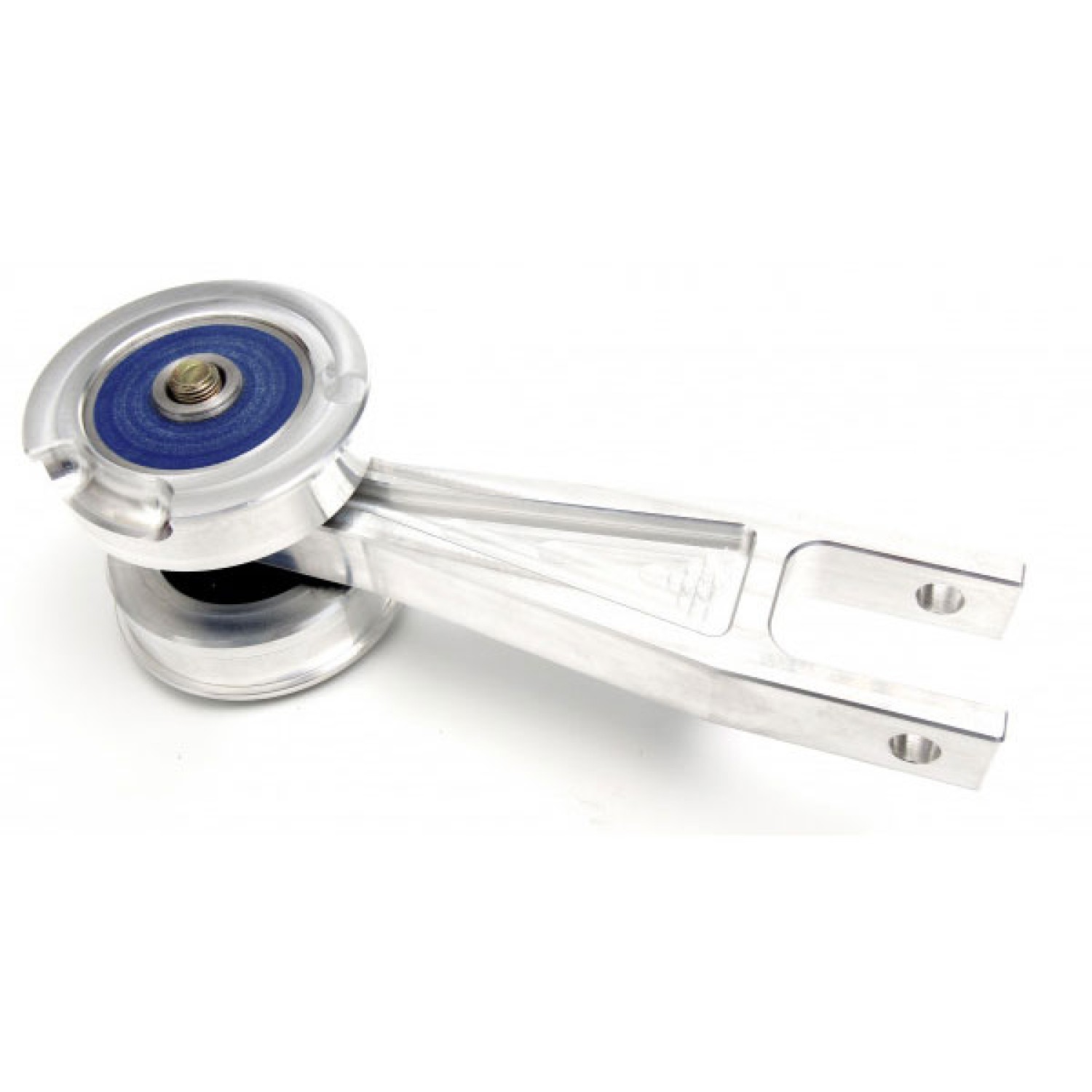
The whole mount is CNC-machined from aluminium and the bushes come pre-fitted. These mounts are the stiffest and are meant for cars with lots of torque, track use and launch-control starts. Examples are the Racingline dogbone for Golf VII GTI/R, Leon III and S3 8V and the Powerflex lower mount for the Hyundai i30 N.
Insert or complete mount?
An insert makes sense if the housing of the standard mount is undamaged and you want an affordable solution. If the original mount is already worn, cracked, or the rubber has separated from the metal, replace the whole mount. An insert in a worn housing will not last long.
Do stiffer engine mounts cause more vibration?
Yes – that is the price of less engine movement. The stiffer the mount, the less vibration it absorbs. The difference is greatest at idle and at low revs. A few things to know before you buy:
- With mild versions (harder rubber, polyurethane around 70A) the difference in the cabin in everyday driving is small.
- With motorsport versions (95A, aluminium) there is more vibration and noise in the cabin – a compromise for the track, not for daily driving.
- On cars with a DSG or automatic gearbox the vibration is often more noticeable, as CTS Turbo also points out.
- If you replace only one mount while the others are worn, the vibration will be greater than with new mounts all round.
How much does an engine mount cost?
Prices in our shop (October 2026, incl. VAT):
| Type | Typical price | Example |
|---|---|---|
| Polyurethane inserts | ~43–124 € | Powerflex for i30 N 43–47 €, Forge for VAG 64 €, Racingline Twin Dogbone 124 € |
| Mounts with harder rubber (CTS Turbo) | ~47–237 € each | Dogbone MQB/MQB EVO 71 €, MQB engine mount 142 €, Audi B8/C7 237 € |
| Kits for high-performance Audis | ~414–828 € | CTS Turbo for Audi B9 414 €, for 4.0 TFSI (S6/S7/RS7) 828 € |
| Aluminium mounts | ~257–485 € | Racingline dogbone MQB 323 €, Powerflex i30 N 369 € |
| HG Motorsport | ~44–169 € | Golf V/VI GTI 44 €, Ford Focus 4 ST 169 € |
Add workshop labour to the price. A lower mount insert is usually a quick job, while replacing the upper mounts requires supporting the engine and costs more. You will always find the current price on the product page.
When is an engine mount upgrade worth it?
- Yes – if you have added power and the engine visibly “jumps” when pulling away or changing gear. On the VAG EA888 and Hyundai i30 N, the lower mount is one of the first upgrades we recommend after a remap.
- Yes – if you do track days. Less engine movement means a more predictable response and less strain on the driveshafts. For what else to prepare, read our guide to your first track day.
- Maybe – if the original mounts are worn and the vague gear change bothers you. A mild upgrade (harder rubber or 70A) costs about the same as the original part.
- No – if you drive a standard car mostly around town and comfort matters most to you. In that case choose the original mount.
What to watch out for when replacing them
- Check all the mounts at once. If one is worn, the others are often not far behind.
- Use new bolts. On many cars the mount bolts are stretch bolts for single use. Some kits do not include them, so order them separately.
- Support the engine safely and tighten the bolts to the torque specified by the vehicle manufacturer.
- Check the exhaust and hoses after the job – a different engine position can change where the exhaust touches the heat shields.
Frequently asked questions
How long does an engine mount last?
There is no prescribed replacement interval. Service life depends on driving style, engine power and heat in the engine bay. On high-mileage or tuned cars it makes sense to have the mounts inspected at every regular service.
Can I replace just one mount?
You can, and with the lower mount this is common. But if the other two mounts are old, the engine will still have play, and the vibration may even increase after fitting one stiff mount. You get the best result when all the mounts are in good condition.
Do polyurethane engine mounts reduce vibration?
No. Polyurethane reduces engine movement, but as a rule it transmits more vibration than new rubber. If you want to cure shaking at idle on a standard car, the right choice is a new original mount or a mild version with harder rubber.
Are stiffer mounts suitable for a car with a DSG gearbox?
Yes, but choose a milder version. With DSG and automatic gearboxes, the difference in vibration when pulling away and at idle is usually more noticeable than with a manual.
Which engine mount is right for your car?
You will find the full range in the Engine mounts category, where you can filter products by brand and vehicle. For suspension bushes and other polyurethane parts, see the Polyurethane bushes category. If you are not sure what to choose, send us your vehicle model, engine, modifications and a description of the symptoms via our contact form. We will help you choose a mount that suits the way you drive.
If you haven’t already, you can sign up for our newsletter using the form below. You can expect more articles like this in your inbox, plus other news from the car world, such as upcoming car meets, track days and other events.